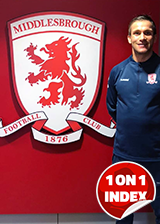
Jordan Tait is a former professional footballer who began his professional career at Newcastle United FC and is currently Development Phase Lead Coach at Middlesbrough FC. Tait played under Managers/Coaches such as Kevin Keegan, Sir Kenny Dalglish, Ruud Gullit, John Carver, Alan Irvine and Tommy Burns. He holds the prestigious UEFA A License, as well as qualifications in Sport Science and Psychology.
Who were the biggest influences on your playing and coaching career?
The biggest influences on my career were my Grandad, my grassroots coach Robert Johnson and John Carver who coached me from 8 years old until I left Newcastle United aged 20.
My Grandad was the one who supported me throughout my career, he used to drive me to training and games most days/nights of the week. I grew up in a town called Berwick-upon-Tweed, which is a 1 hour drive from Newcastle where I first joined a professional academy and later began my professional career. My grandad would drive me to Newcastle 3 nights a week after school to attend training and on Sundays to play games, so was very time consuming for him and my family.
My Grandad literally travelled the world to watch me play. I remember in 1998 whilst playing for Newcastle United as an 18 year old we travelled to Texas to play in the Dallas cup, when I was coming in from the warm up I looked up to the stand and my Grandad was there snapping away with his camera. I had no idea he was going, he booked flights and travelled to the US with a teammates parents to watch our games.
A Coach called Robert Johnson took my local Grassroots team (Berwick Rangers Juniors) and he was also a big influence on me in terms of discipline and setting the standards required to take the next step in the football/soccer world. This definitely gave me a good grounding and as all I ever wanted to do was to become a professional player I took his guidance onboard and it certainly stood me in good stead both in the game and life.
John Carver has been a big influence on me both as a player and a coach. I have known JC since I was 8 years old when he was a young coach at a summer soccer camp in Newcastle. He later went on to coach the youth teams at Newcastle United, working his way up the ladder to eventually managing the first team as well as various other clubs in Europe and the MLS (where he was head coach of Toronto FC). JC’s coaching sessions were fantastic and I thoroughly enjoyed them as a player, so I base a lot of my coaching on my experience working with him. We still talk regularly and he’s always there should I need to talk about anything, it's great to see him now working with the Scotland International team and they’ve just qualified for next year's European Championships.
Who were some of the stand out players you played with and against?
I was fortunate enough to be a professional player at Newcastle United in the mid 90’s when they were at the top of the Premier League and challenging Manchester United for the league title, so the quality of player we had at that time was exceptional. Alan Shearer was there having signed for what was then a world record transfer fee of £15m. Others include David Ginola, Tino Asprilla, Peter Beardsley and Aaron Hughes (112 caps for Northern Ireland). I remember a game in training one day and trying to tackle David Ginola but I could get anywhere near the ball! During my time at Newcastle I played Centre Back next to Stevie Caldwell who later went on to have a good career playing in the MLS with Toronto and now works on Canadian TV.
Later When I played in Scotland I’d say the best players I played against were Claudio Cannigia, Frank and Ronald De Boer and Lorenzo Amoruso who were all at Rangers. They were top players who had represented their clubs and countries at the very highest level.
At what stage did you realize that you would like to pursue a career in coaching?
Being obsessed with Football/soccer from as far back as I can remember, I’ve always been a student of the game. At 17 years old John Carver advised me to take my first coaching qualification through the English FA, which I completed and absolutely loved it. Since 17-18 years old I knew that when I finished playing I’d like to progress into coaching. I used to go home from training everyday and write down what we had done during the session that day and so now have a rather extensive library of sessions at my disposal.
How has the game evolved at Academy level from your playing days to now coaching?
The Academy system has evolved a lot over the past 20+ years. Things are now more technical in terms of the various departments involved with the Academy players at a young age. At my club (Middlesbrough FC) we now have specific sport science, video analysis, medical, education and recruitment departments, which is then broken down into specific age brackets etc. This is very different to when I was 9-10 years old and beginning my academy journey where it was a few scouts, a coach and a physio. We’re still progressing all of the time and it's certainly much more beneficial for the current Academy players. As we say “the player(s) is/are the syllabus“
Which players have you worked with on a 1 on 1 basis?
Here at Middlesbrough FC, we have an excellent reputation for developing our young players and progressing them into our first team and elsewhere in the Professional game. I've worked with players such as Dael Fry, who has won the European Championships and World Cup with England (under age teams). Another of note is Martin Braithwaite, the Danish international striker who now plays for FC Barcelona in La Liga.
What are the main benefits of 1 on 1 training for soccer players?
1 on 1 training has great benefits for soccer players. This is where a coach can really identify and work on the fine details of what an individual player needs. From the players point of view they will get specific sessions/drills that are purely designed for their own benefit. They'll get a lot of repetition and touches of the ball whilst they’re developing areas for improvement as well as making the strong parts of their game super strengths. I think coaches often only identify and work of deficiencies, but why not also work on a players strengths to make them as we say “super strengths”.
Which attributes separate elite players from the rest?
In my experience the main attribute that separates the elite athlete from the rest in mindset/psychology. Sport at the elite level is heavily reliant on the psychology on the athlete/player. By this I mean does the athlete/player have the psychological ability to handle performing when it really matters? Outside their comfort zone in high pressure situations in-front of 60,000 fans and millions watching on TV?
The England Manager, Gareth Southgate has done a lot of work on this with the England National Team, who we all know used to regularly get knocked out of tournaments on Penalties. Prior to the last World Cup in Russia, England worked a lot on repetition and the psychology around the process of taking a penalty. Granted you can never replicate the situational pressure of the occasion but England worked on the psychological side of things and he often used the term “own the process” which I really liked. England then went on to win a Penalty shoot -out against Colombia in that World Cup.
Again on mindset, people only see the end result of performance, but what they don’t see is the endless hours of hard work, sacrifice and sweat that has gone in to achieving that end result. The question is, does the athlete/ player have the mindset the discipline and drive to get up and go to practice even when they don’t feel like it, or on a cold, dark morning when everyone else is still in their bed?
Published